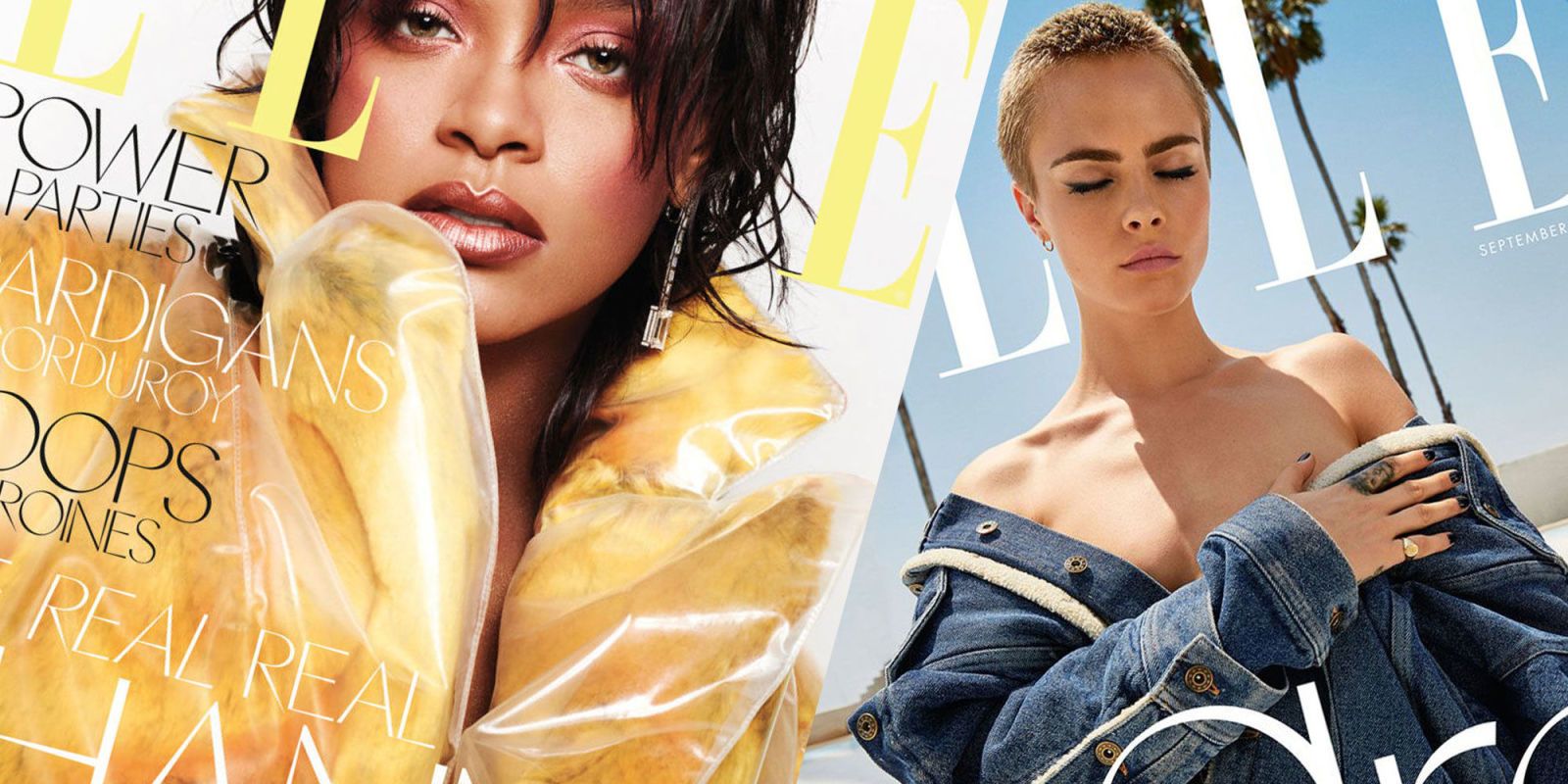
What does your best friend mean to you? We're working on a friendship feature and it's got us thinking about everything our friends do for us. Can you sum it up in 140 characters? Tweet us @ELLEUK
Summer
is finally on the way and to celebrate, we want to know the songs that make up your soundtrack to the season. What will be playing on your iPod as you lie on the beach, sun on your face and copy of ELLE ready to devour? Tweet us at ELLEUK
- #ELLEsummerplaylist
Style For Less
Wild Prints
, Fresh Shapes and Upscale Accesories. When the high street
is so good, why shop anywhere else?
Style Spy
What other people wear to work.
This month, a designer-in-their-studios special, asking what inspires them about the women who wear their clothes. Including Mary Katrantzou
, the winner of the NEXT Young Designer of the Year award at this year's ELLE Style Awards.
The spring jacket has a lot to answer for. The key to trans-seasonal dressing, the right one will transform your look. Just add trousers for the perfect boy-girl mix.
The Rise of Raf
Dior’s newly appointed artistic director, Raf Simons met ELLE’s Rebecca Lowthorpe in 2009. How did a self-taught designer who had never cut a dress in his life become fashion's most sought after talent?
I meet Raf Simons in Coin, the garish neon-lit department store in downtown Milan. It’s a peculiar place to meet one of the fashion world’s most influential designers. Needless to say his creations are not stocked here. As I make my way up to the top floor and out onto the chilly roof terrace with only a plastic canopy for cover, the reason for this particular location soon becomes clear. In the corner, a seating arrangement is marked with a ‘Riservato’ sign and a table dotted with five ashtrays. I am about to watch Raf Simons consume a pack of cigarettes in two and a half hours. ‘I started smoking when I split up from Veronique… I had a broken heart,’ he explains of his former girlfriend, the Belgian designer Veronique Branquinho, who he dated for five years at the beginning of his career. This is quite a confession – not the loss of a love that caused him to smoke like a chimney but the fact the love is a ‘she’. It’s not often one gets to meet a heterosexual fashion designer, or at least one who will admit to it. Although later when I ask him to clarify – ‘Does he have a girlfriend at the moment, or a boyfriend, maybe?’ – he just blushes and swerves the question with a ‘Noo no, no, noooo.’
Three things make this Belgian designer remarkable. First, he is probably the most important menswear designer of the past 15 years, credited with jump-starting the punky deconstructed uniform so prevalent among today’s urban youth – skinny black suits cut small in the shoulders, the ubiquitous hoodie, the baggy-and-layered look. He shows his menswear in Paris, often in huge cavernous venues or wide-open city spaces, and instead of using agency models, he prefers to cast waif-like teenagers off the streets of Antwerp – some have walked for him for 10 years or more. He is known for celebrating the beauty in the ordinary, so there’s a cool, gritty reality to Simons and his brand – an image that has long since infiltrated high-street chains like Topman and influenced celebrated fashion photographers like David Sims (with whom he collaborated on a book of portraits, Isolated Heroes).
The second remarkable thing is since 2005, he has had creative control of Jil Sander, the cult womenswear label revered as much for its cutting-edge vision as for its unapologetically minimal tailoring. To have to follow in the footsteps of a legend such as Jil Sander is one thing, but to have to follow in those footsteps without ever having designed a dress before is quite astonishing. ‘I was very scared indeed,’ he says, sucking in a ring of smoke. ‘It wasn’t just stepping into her shoes – it was designing womenswear for the first time. She was so respected, really, really respected, that I didn’t think people would give me a chance.’ When he took over, the label’s credibility was on the slide, having been designed by a rudderless design team for three seasons following Sander’s acrimonious departure. She had left the company she had founded, for the second time at the end of 2004, citing irreconcilable differences with her new boss, Patrizio Bertelli, the husband of Miuccia Prada and CEO of the Prada Group, which had bought Sander’s company in 1999. The fashion world was aghast at her departure – store buyers in particular reeled at the news.
‘When Raf’s name came up, I thought, “Oh god, here we go”,’ says the legendary Joan Burstein, owner of designer emporium Browns and loyal devotee of Sander’s from the beginning. ‘But he was clever. He started out by respecting the label and he gained the respect of the buyers and customers. And now he’s freed himself from the Jil Sander reigns – he’s more expressive. His whole vision, how he sees a woman, it’s beautiful.’ The spring/summer 2009 collection, pictured here – the most romantic of cutting-edge clothes where silken fringes swathe everything from jackets to body-contouring dresses – was widely regarded by editors and buyers as one of the top shows of the season.
And the third remarkable thing? He has had no formal training in fashion design – not even so much as a single lesson in pattern cutting, which makes his accomplishments all the more extraordinary.
So how did he do it? How on earth did this quiet man, now 41 – today dressed surprisingly like a Milanese City banker in head-to-toe black Jil Sander cashmere – scale the heights of fashion without us ever really getting to know him? This is a designer who wants to fly under the radar. The fact you might not have heard of him is precisely how he likes it. He would rather remain anonymous to the world he influences than give endless interviews. Indeed, this interview had to be rescheduled three times.
To understand what makes him tick, you need to understand his… Belgian-ness. Imagine for a minute all the fashion nations reduced to caricatures: you’d have the Americans representing feel-good uncomplicated clothes, the Italians as flamboyant and sexy, the French impeccably chic, the Brits as creative eccentrics, the Japanese as avant-garde conceptualists. And the Belgians? They’d be fashion’s dark Goths – cool, experimental, serious. I should say here, however, that Simons’ intimidatingly cool image doesn’t match the man. In person he’s warm, gentle and forthright.
I ask Simons what it means to him to be a Belgian designer? ‘That, I don’t know. I think you should tell me because they always ask me this and everybody thinks it’s a group of designers and it’s not,’ he says. One thing is for sure: Belgian designers don’t like to be grouped. The first generation of famous designers to come out of Belgium in the early 1980s – a decade before Simons started – were known collectively as ‘The Antwerp Six’ and included Dries Van Noten, Ann Demeulemeester and briefly Martin Margiela – all of whom at the time, it seems, resented being lumped together instead of being allowed to shine individually. ‘I think with the first generation it all got very tense. At least, what I know from Martin is he had the desire to be on his own, he couldn’t have that kind of group thing going on.’ Simons wonders if the strong image that binds ‘The Belgians’ is down to the fact they all spent so long in the same place: Antwerp. ‘It’s more like a village, it’s very small, very non glamorous… everybody is just very isolated. Sometimes you run into each other but it’s at the bakery, not a party. You present yourself through your work.’
Simons grew up in Neerpelt, a small town close to the border of Holland. ‘I’m not growing up with culture there, eh? I am actually brought up between cows and sheep.’ An only child, he was sent to the local Catholic school, which he describes as ‘uncreative and uninspiring’, but he decided to make the most of it for the sake of his parents. ‘They were both from very big families of nine or ten children with absolutely no possibilities,’ he says of his father, who joined the army at 16, and his mother, who worked as a cleaning lady. ‘The only thing they ever said to me was, just take it serious your school.’
By the age of 17, Simons had developed a taste for avant-garde post-punk music, buying up Joy Division, New Order and Kraftwerk records from his local music shop, but he knew nothing of fashion or art school. He resisted his teachers’ efforts to steer him in the sensible direction of law or medicine and instead decided to go off and study industrial design in Genk. ‘For the first time I saw all these kids, how they were dressed, how they acted and performed, so easy and so completely not like at my school. Everywhere they were making things, it was so creative.’ He studied there for four years during which time he designed door handles, a bicycle for a handicapped child, furniture and car designs.
It was during his third year when, having become friendly with fashion students at the Royal Academy of Fine Arts in Antwerp, he decided he’d like to do an internship with Walter Van Beirendonck (one of the original Antwerp Six). Being an industrial-design student, Simons was so worried the fashion designer wouldn’t want him, he made up a fake fashion portfolio. ‘He flicked through it really fast, like he wasn’t interested, but then at the end he noticed, stuffed in the back of the portfolio, my real work from college – it was an eggcup design… That’s how I ended up making things for him, like a perfume bottle, or a mask or furniture for his presentations.’
Van Beirendonck showed his collections in Paris and took Simons with him to help out. ‘He took me to the first fashion shows I ever saw in my life,’ he says. These included a Jean Paul Gaultier show that had models rising up through the floor on revolving turntables and a Martin Margiela show that took place in a poor immigrant neighbourhood of Paris with local children dancing down the improvised catwalk. ‘That was the moment I perceived fashion in a different way,’ he says.
Later that year, he graduated from his industrial-design course with furniture inspired by the human body. Still, Simons didn’t jump straight into fashion design. It was two years (working as a furniture designer) before he took a small collection along to Linda Loppa, the then-head of the fashion department at Antwerp’s Royal Academy of Fine Arts (the Belgian equivalent of London’s Central Saint Martins) who was so impressed with Simons’ first attempts at menswear that she not only put him in contact with her father (a brilliant tailor) but also sent him off to Italy to get a manufacturer. ‘I didn’t say anything to my family about it… My father wears a pacemaker. He’s a healthy boy, eh? But also a very traditional man. He didn’t know what is fashion… Of course, now, they are very proud.’
It has started to snow on the roof terrace and the Jil Sander PRs are trying to prize Simons away back to the design studio, but he wants to smoke another cigarette, so I ask him, ‘Can you tell me about the biggest passions in your life?’ First, he talks about his love of art and the fact that if he wasn’t a designer, he’d be a curator or art buyer. ‘You know, I really like to see art and buy art.’ Does that mean he’s very rich? ‘Well, ja, it’s not cheap. But I never save money, eh? I spend every penny on art.’ He owns work by the sculptor Steven Gontarski and Don Brown, painters Dana Schutz and Daniel Sinsel and the last thing he bought was a piece by Evan Holloway.
The conversation leads to the Art Basel art fair and a chance encounter with Jil Sander. ‘Please,’ he says, leaning in, ‘I ask you to be careful how you write it because it’s a very weird situation.’ He goes on to explain: ‘She saw me and I saw her and it was a little bit this uncomfortable situation, like, what should we do now? So I thought I would be a gentleman, I went over and shook hands.’ He is at pains to be as diplomatic as possible. ‘I feel very sensitive towards her because I know, if the same thing happened to me, if it were my name, my brand…’ he trails off. I wonder, if he was in her situation, who he would choose to follow in his footsteps? ‘Nicolas Ghesquière (the creative director at Balenciaga). He’s the only one I would put on my brand… Or maybe Miuccia (Prada) would be interesting.’
Back to his passions. Who does he care about most in the world? ‘My mum, my dad… and Robbie,’ he says, describing the much-tattooed young man who used to be the face of Raf Simons and now runs his studio in Antwerp. ‘Robbie is a brother to me… he is my blood. If he said to me, “I can’t stay anymore”, I’m out. I stop everything. I can’t be in fashion without him.’ He says this so passionately, it’s easy to see how people might confuse his sexuality.
And fashion design – is this a true passion? ‘Well, it’s true, it takes away all your private life… it takes away your private time, you know? Fashion doesn’t know the word stop… but at the same time it’s so attracting, so strong, it’s just so fascinating.’
Discover ELLE’s pick of the best TV, films, music, books and art in May Preview.
Having a Ball
Erdem’s exclusive illustration for ELLE gives a glimpse of the glamour and drama to expect at the V&A Museum’s exhibition
Ballgowns: British Glamour since 1950, from the 19 May.
Rebel, Rebel
Attention grabbing, rising star Azealia Banks talks to ELLE about her new music, being Nicola Formichetti’s muse, and those X-rated lyrics.
Supermodels take Hollywood
ELLE cover girl Agyness Deyn makes the transition from model to actor
in the crime thriller Pusher, out in May. Agyness follows in the footsteps of fellow British model Lily Cole, who stars opposite Charlotte Gainsbourg and Pete Doherty in Confessions of a Child of the Century, out in autumn.
Venus rising
Your summer wardrobe has a new rule book this season – more is a little bit more, for once. Yes, you can strip it back, but don’t overdo the display of skin. Hints of metallic
and plastics keep it modern
Is this the future of fashion?
Could the internet – and Twitter, Tumblr and pinterest – have the power to turn fashion from an elite club into a (very stylish) global democracy, asks writer Jim Shi
Be the first to see films for free
This month, ELLE offers you the chance to see a preview of Cafe de Flore starring Vanessa Paradis.
Be one of the first to see Vanessa Paradis’ new film Café de Flore at the special ELLE preview screenings held nationwide. A mix of love, fate, mystery and music, Paradis is a spirited single mother in 1960s Paris. In the present, Kevin Parent plays a French-Canadian DJ who baffles his family by leaving his childhood sweetheart for another woman. A stylish, award-winning drama, Café de Flore features an infectious soundtrack you’ll love.
Screenings will take place at 14 venues across the UK on Monday 23 April. (Cineworld Birmingham;Cineworld Bristol; Cineworld Didsbury; Cineworld Dublin; Cineworld Glasgow Renfrew Street; Cineworld Nottingham; ODEON Covent Garden; VUE Islington; VUE Westfield, London; Empire Newcastle; Independent The Workshop, Sheffield)
Each reader may claim up to two tickets. Readers who successfully book tickets must present page 113 of the May issue of ELLE UK with the ticket and have ID available if required. To book your free tickets and for full terms and conditions, click here
.
The ELLE screening code is 392750. ELLE club readers can use this code to get early tickets- 139247
Leading light
Beautiful. British. Down-to-earth. Seriously talented. The alluring face of Yves Saint Laurent’s most-iconic perfume. And funny. Really, truly funny. Hanna Hanra discovers that Emily Blunt is full of surprises
.
The incredible world of Fendi
Once upon a time there was a leather-goods label that turned into a style dynasty. Janice Turner talks to Silvia Fendi and uncovers a story of family and fashion.
The full body boot camp
The beach beckons, so we’ve rounded up all we know about the smartest, fastest ways to get in shape
. It’s your better-body cheat sheet.
Take me with you
Here’s where the fun begins. Did you ever see shoes, bags, sunglasses and jewellery with such irresistible personality? It’s full-throttle fashion…
Laser quest
The potential of laser treatment is vast. From tackling fine lines to turning back the clock, they can work miracles. But how dangerous are they?